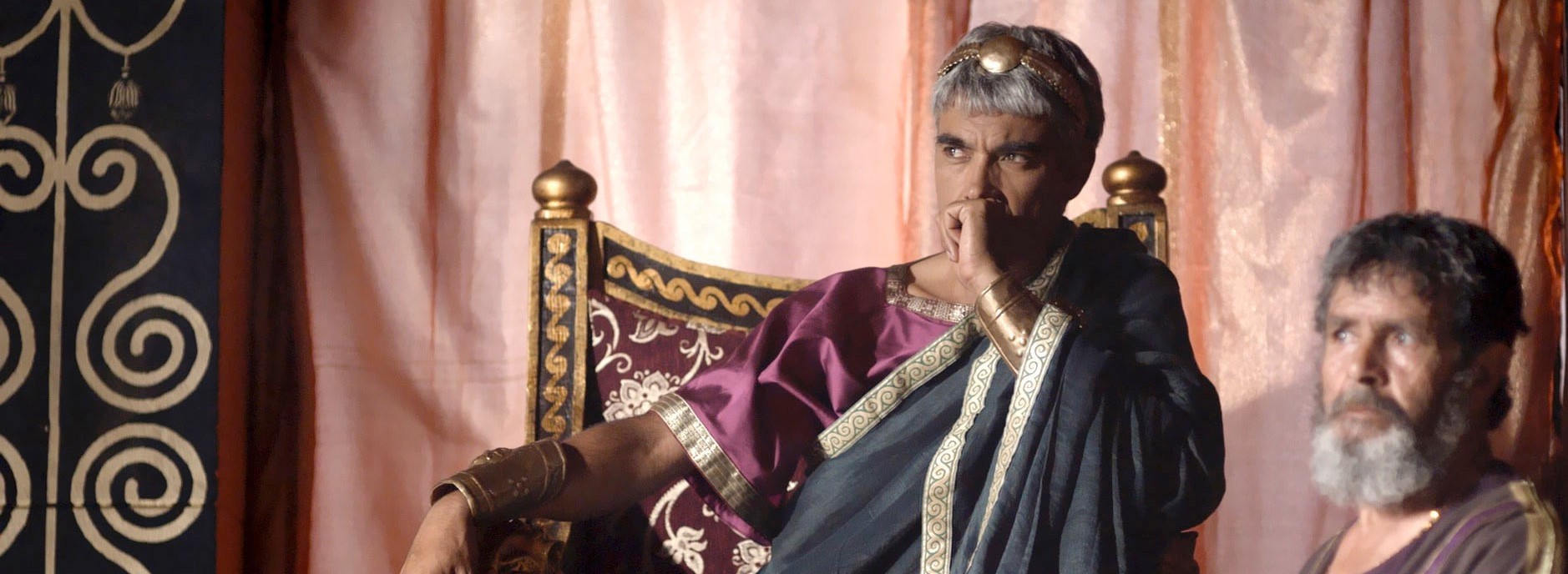
Herod’s steward gives us the whisper from the palace…
I’ve just come from the king’s chambers and, I tell you, he’s getting worse!
There’s a foul temper on him today. Already he’s cursing and throwing things. He hardly slept a wink again; tossing and turning all night. His sleep was haunted by nightmares, and his daytime thoughts are much the same. Guilt drives him to despair and fear grips his soul and no tonic or draught from the doctors has helped in any way. The wine, of course (which he has started on already!) just exaggerates his feelings and leads to more mood swings and violence. I tell you, I was glad to get out of the room as soon as I could!
Herodias, the king’s wife, has given up on him for now (wisely keeping her distance). Not that she has much time for him at all these days. She looks at him with disdain whenever she sees him.
His favourite muse, little Salome, dare not go anywhere near him! Normally, she would manage to calm Herod down, but her wiles and ways are what got him into this mess, he fumed when she came to see him. He got so riled up at the sight of her that she only just had time to duck out the door as he viciously threw his wine goblet at her. Outwardly Herod blames the girl and her mother for everything. But, deep down, he knows the responsibility – and the stupidity – was his and his alone. (But don’t tell anyone I said that, mind. I really don’t want to lose my head too!)
Now, John always unsettled Herod. Yes, he was fascinated by him; something about John holiness and his unbending integrity drew the King to him . These were qualities Herod recognised and respected, even if he had none of them himself. What is more, the King saw that John was powerful. Not only did he have an authority that seemed to come from God, John also had had a massive following. How a backwoods preacher could carry such authority really bewildered Herod. He was drawn to it and wanted to learn from it, while utterly rejecting it at the same time. So, ironically, he became his tormentor’s protector. That just made Herodias mad!
It may have just been that Herod was astute enough to know that, with John having such a large following, there was no way he could dispose of him without a backlash. But I honestly don’t think Herod actually wanted anything bad to happen to John. Yes, he was angry at the blatant challenge to his morality that John persisted with, but the King could not really argue that case. Whatever spin Herod might have liked to put on it, he had taken his brothers wife as his own. Others may have turn a blind eye, but you could not expect John to. Even Herod knew it was wrong, but he was in too deep and … he just could not help himself.
What he could do was keep Herod locked up. In the mountain fortress of Macherus, John was out of the way and unable to cause any more trouble. Holding him in his fortress palace, meant Herod could keep an eye on him. And visit him too. He was constantly drawn to John and went often to speak with him. I’d say John puzzled him – Herod just could not understand the man’s way of thinking. And clearly John got under his skin. Herod often came out of their meetings cursing and swearing that he’d never to listen to him again but, of course, he did. He returned time and again, as if pulled by a magnet, or drawn like a moth to the flame. Why? I do not know! I wish he hadn’t let the man affect him so. It all seemed masochistic to me! Maybe, this was Herod’s way of doing penance? Certainly, John never let up on challenging Herod, and Herod knew he never would. Perhaps he found it easier to take John’s condemnation, than face his own inner tribunal instead?
Herodias thought Herod weak, for sure. She had no qualms about wanting to see John dead. And now Herod can no longer carry on the self-pretence that he is good – the protector of a Holy man. That ended at the party, when in drunken revelry, he allowed Herodias to manoeuvre him into getting her way.
The queen knew the effect her daughter had on Herod. Perversely, she was entertained by his drooling over the girl. It thrilled and disgusted her at the same time. But now she decided to use it to her advantage.
She’d trained Salome to dance so voluptuously, and this was the moment to see her efforts reap the desired fruit. A potent mixture of way too much wine, the King’s foolish bravado and uncontrolled lust conspired to have their way; just as Herodias knew they would. Without thinking, Herod declared he’d give his seductress anything she wanted. He could not have known what she (at her mother’s bidding) would ask for. But in that moment of supreme stupidity, he’d given his word and would have to stick with it. No way would Herod allow himself to lose face. So instead, John lost his head.
And now Herod has to live with the consequences. He’s tried to put a brave face on it; tried to act with a dignity that he knows he lost that night. Tried so hard to forget what he allowed to happen. Tried to forget John and everything he stood for. “But that wretch; he still torments me from beyond the grave!” he rants in mad despair.
Reports had come in, and Herod was hearing about another Holy-man rising up in John’s wake. This man was rapidly growing in fame and the people were flocking to him in numbers greater even than they had to John. The reports said he was a miracle worker, who sent his followers out to heal and drive out demons… and apparently they did so effectively, too. Worse of all, this man was said to be John’s cousin (he had to be, didn’t he?!) Others were claiming he was much more; Elijah? A prophet? Or – wait for it – John the Baptist raised from the dead?!
It was that last suggestion that did it for Herod. He just could not shake the notion from his head. His one-time mentor and tormentor, both, was back to haunt him! Burning guilt mixed with superstitious nonsense to make up a potent concoction. For, if John had been raised from the dead, where did that leave Herod? Judged and condemned as John’s killer, with his tormentor still out there and coming to get him – that’s where!
So, no wonder Herod can’t sleep! No wonder he spends his days trying to lose himself in drunken stupor. You see, if someone does rise from the dead and you can’t kill him and his truth, then there is no escape is there? Except, perhaps, though that one thing John was famous for calling people to: repentance. An admission of guilt, a turning from it, and a throwing of oneself on the mercy of God. But no way would Herod ever do that. He would never allow himself to lose face. Never!
So, he’ll have to live with the constant torment, even if it eats him away inside.
And I’ll have to live with his moods and the abuse he hurls at me when I go to wake him each morning.
And this new guy they’re all talking about had better be very careful. The first time Herod was tricked in to it, but now, I’m certain, he’ll most certainly want to see the man dead.
Thaddeus tells us about a difficult visit to Nazareth and his experience of being sent out:
We have been sent out by Jesus, the twelve of us. He paired us up and sent us out like Noah’s animals, two by two. That’s better than going alone, but it’s still rather scary! Thankfully my partner, Philip, is good with people and a natural enthusiast for Jesus. His friend Nathaniel, a bit of a sceptic, was not chosen to be one of us, so Philip was glad for someone to partner with. We will get on well together, whatever we may face.
I wonder how they will respond when we come?
I say this because Jesus has just had a very bad experience. He took us home with him, up the mountain to Nazareth. It’s a small place, with a very tight-knit community and many living in cave-houses, would you believe it! Not much to see and do there, but Jesus wanted to visit. Perhaps, he hoped to patch things up with his family after he upset them in Capernaum? Or, maybe, he wanted to re-assure them he was safe after what had happened to his cousin, John?
Actually, his family didn’t give us any trouble. It was the neighbours who kicked up a stink. They wanted to hear from him, and invited him to speak in the synagogue. He did so gladly, but they just could not get their heads around the fact that it was Jesus talking to them like he did. I mean, ‘Where did he get that from?’ they asked. ‘Isn’t he just the carpenter we have always known? Isn’t he Mary’s son – brother of James, Joseph, Judas and Simon? Don’t his sisters live just round the corner? So where does he think he has got all this ‘wisdom’ from? He’s not fooling us that he is anyone special; we know he is not!’
They just could not let Jesus out of the box they held him in and they were offended by his claiming to be something else. Carpenters don’t get to be Rabbis around here (let alone the Son of God!)
For his part, Jesus was shocked and astonished by their reaction – their complete lack of faith. Everywhere else, people were speculating that he was Elijah or a prophet. Even Herod, in his guilt, thought he might be John the Baptist come back to life! But here, his own people insisted he was a nobody! Perhaps they had really come to believe the saying ‘Nothing good ever comes from Nazareth’. Hear that enough times and maybe it becomes a self-fulfilling prophecy.
Jesus put a brave face on it, remarking philosophically that a prophet is never recognised in his own town. But I could see he was hurt by it. He called the visit off early, moving on sooner than we expected. There was no point staying where you were not welcome. His time could be better used. His hands were tied here, you see, being as they would not let him do or say anything. (But he still laid hands on a couple of poor folk and they were healed!)
So, when he sent us out, he wanted us to learn from that experience: ‘If you are welcomed, then stay in the town. But if you are not welcomed, then don’t worry: just brush the sand off your feet and move on. Don’t let any sense of rejection stick. There will be plenty of others who will be glad to welcome you. And you won’t need to take anything with you, because they will happily provide.’
He was right! Though we went out in trepidation, we came back rejoicing. Most people, it turned out, were so welcoming. They were hungry to hear about Jesus and his message. In his name, and with his authority, we were able to drive out all kinds of evil spirits and many people were healed.
And so, Jesus’ name was being talked about everywhere and his fame was spreading throughout the land. Except in Nazareth, where he remained a nobody. Funny that, isn’t it?
There are three parts this time. In the first, Jairus speaks as a Father, in wonder and gratitude. Then he thinks twice in his role leader of the synagogue.
Each part may stand alone, but all three could be used the same act of worship, interspersed with hymns and prayers
Full of the Joys of Life
Just look at her! I can hardly believe it! All I want to do is to take hold of her and feel the warmth in her body and the strong beat of her heart (just to be sure, you know?). But not a chance! Look at her, running and laughing and shouting and playing, just like any other child of her age. Full of the joys of life! Life, can you hear yourself say that, Jairus? She’s full of the joys of Life! Oh, I can hardly believe it! I can hardly believe it!
Yesterday… Oh, I can hardly think of yesterday!
The coldness… the stillness…
Now that’s all in the past, thank God. That dreadful, threatening cloud has moved on.
And today the light of life shines brighter, I’ll tell you, than it ever has done before!
The light of life shines brighter!
I think that some will be persuaded I acted rather foolishly. For sure, I’m in the black books of some of my colleagues at the synagogue. It’s not quite ‘dulce et decorum’, not quite ‘right and proper’ for a man in my position to make such a public spectacle of himself. Especially when, in doing so, he draws attention to and gives credibility to a ‘pretender’ such as Jesus! (Not that I care about that. Look at her! Listen to her; she’s singing now! Jesus didn’t pretend when he gave her back to me. And what could they do to help, eh!?)
Mind you, looking back, I really did think some foolish things yesterday. Be honest, Jairus; more than foolish, I thought some really terrible things. I got so impatient and so … angry. First there was the crowd pressing in from every side. Couldn’t they tell we were in a hurry?
Couldn’t they just hold their curiosity for once and let us get on and get home!? Then there was that woman who had the audacity to steal his power away from Him. And then there was Jesus. I mean, why did he have to stop and make a scene of it just then of all times?
He was carrying on as though we had all the time in the world. He stopped and insisted on
calling that woman out, waiting for her to respond and … oh, it’s awful to remember what I thought in those few moments! He gave her time. My time! My so very, very precious time! To be honest, I was furious. A stillness and a silence may have descended on the crowd, but my heart was racing and my mind urging him to hurry. Hurry! ‘Come on man, don’t you know that she is dying?’
‘No master, don’t you know that she is dead?’
I didn’t want to see the messengers. But as they came pushing through the crowd I knew, even before they told me. And for a moment my world stood still. Then the crowd and all around me began to spin. I saw it again and again in repeated slow motion: Jesus (back to me) talking to the woman, them pushing through the crowd, my servant’s voice taking on haunted tones as his lips became larger than life and everything else span out of focus, those lips intoning time after time after time: ‘she’s dead … she’s dead … she’s dead!’.
Then, all of a sudden, I was back in the crowd again. And for an awful moment I felt terribly afraid.
‘Do not be afraid’, a tender but authoritative voice was saying, ‘Only believe and she will be well.’
‘Only believe’, huh?! And did I? Who can tell? Was it resignation – one last clinging after hope – or was there something in his voice that spurred me on? Either way, it was quite clear that Jesus was with me, and he had now taken control. I had the fullness of his attention at last. I needed it, because I don’t believe I could think nor do anything for myself. And one thing’s for certain; if I wanted anyone to be around when I got home, then it would have had to be Jesus.
Oh, and I was so glad for his sensitivity! I don’t think that I could have borne it if he had made a public show of things like he did with that woman. But no, He sent them all away, even most of his disciples. Except Peter, James and John, I think. Yes, just the six of us; that’s all he would allow into the house.
And, in the house, there was that terrible show. The widows! The professional mourners! Hard away at it, they were. You could hear their penetrating wailing all the way down the street. Those cries practised to be so perfect; so full of pain, hopelessness, and despair. I resented them being there.
And then the showdown that sealed it all: ‘Don’t cry! The child is not dead. She is only sleeping.’
If I have ever felt stupid and embarrassed, it was then, when Jesus said that! I would have readily joined in their laughter if it hadn’t been my child lying there, lifeless and still.
But when Jesus moved so purposely towards her, I was presented with a choice. Believe them and their hopeless and wailing despair, or Him and his power, authority and love?
It was then that I remembered the woman. So desperate and so afraid, she had reached out to him. In that moment, Jesus had given himself to her and she had been healed.
The decision had been made. I gave him his way as he took my daughter by the hand.
Again, that voice, so authoritative, so sure: ‘Get up, my child!’
Can you believe it? Something so simple! Just that: ‘Get up, my child!’ and she did!
Then the laughter stopped, I tell you!
But not for long! There she goes again! Listen to her; full of the joys of life! The joys of LIFE! I could sit here all day simply looking and listening and enjoying her!
And … oops! … I think that’s what I’d better do! I’ve just remembered something else that happened yesterday; Jesus told me not to tell anyone about all this!
Well, my friend, I am sorry! I’m afraid I just couldn’t help it!
That woman!
There’s something I should tell you about that woman I mentioned. I quite forgot about it in all the excitement, but suddenly it dawned on me; I knew her.
Of course, in a small town such as this, this should be no surprise; everyone knows everyone! But, if I put it slightly differently and say ‘this woman was known to me,’ then you might begin to understand what I mean. I know her professionally. I am the leader of the synagogue, after all, and this woman is one on the barred list. It’s the bleeding, you see; it makes her unclean. Laid down in the Law, it is. Leviticus 15, if you really must know. And it is my duty to uphold that law. In this case, to make sure she is refused entry to synagogue and kept out of society. No one else, after all, wants to be made unclean by any contact with her.
Normally, you know, it’s only a short-term thing. When a woman has her monthly bleed, she is ‘unclean’ for seven days. If she bleeds at any other time, she is unclean for seven days from the time it stops, so on the eighth day she can take an offering to the temple and be declared clean again. In the mean time, no one can touch her, or sit on a bed she has slept in, or even eat food she has prepared. She is barred from all public life and places… but as I said, it’s usually only for a short time, and then the woman is welcome back.
This woman, however, has been an untouchable for years. 12 years to be precise. And don’t I know it well. It all came flooding back to me when I remembered what happened yesterday. The two scenes formed an almost perfect mirror image in my mind.
My servants were at the door (the same ones, only looking at lot younger then!). I had been expecting them, and my heart soared with joy and excitement when I saw them trying to get my attention. The poorly concealed smiles on their faces said it all. ‘Come home master!’ they were there to say, ‘You’re a dad at last!’
How I longed to leave straightaway, but as I made my way across to them, with the all-important question (‘Boy or girl?’) on my lips, I was stopped in my tracks when the woman stepped between us. She stood there with a pleading look in her eye. So silent and so tragic, I just simply just could not ignore her. She didn’t have to explain much before I knew what I must do. Can you believe it? On the very day that I celebrated the new born life of my child, I had to condemn this woman to nothing less than a living death! I declared her ‘untouchable’ and then rushed home to hold my new born child!
I see the tragic irony of it all now. Of course, it was not my fault; I had no choice. I knew it would be hard for her, but no-one could have expected it to last. But it did. And no intervention from any doctor could help. She kept bleeding, so she remained an outcast and it was my job to enforce that. Everyone accepted it. Those who didn’t condemn her, assuming it was some divine judgement for hidden sins, took it as a hard luck story, that’s all. No-one questioned it. No-one cared. Why should I feel guilty?
And how ironic it is, that all these years later, as I sought to take Jesus to my dying daughter, it was this same woman who stood in the way once again!
To be honest, I didn’t recognise her immediately. I didn’t see her in the crowd and, to be honest, I was so distressed at the time I couldn’t have said anything any way.
Not that anyone would have seen her at all, if Jesus hadn’t called her out. Most people I know would not have made a spectacle of this, if they could have helped it. They would have kept quiet and hoped for the best. Ritual impurity is very contagious, you see. It only takes one touch from an untouchable and you are persona no grata for the day as well!
So, Jesus could have got away with it. And if you had asked me at the time, I would have said he jolly well ought to have ignored her and come away immediately. My daughter was dying! Only twelve years old. Still a child. Her future stolen away far too soon. Surely, he could see my daughter was far more important? Why choose now to bother with an unclean woman such as this?
But he knew what he was doing, didn’t he? He knew that she had touched him, and if he hadn’t read my mind exactly, he knew exactly what I was thinking! ‘My Daughter’, he called her. And If I had been more able to listen at the time, I should have heard what he was saying; ‘My daughter!’ This woman too was his daughter. While my thoughts we so wrapped up in my poor child, his heart was breaking for a child of his own; the one who, twelve years ago, I had sentenced to a life less than life. The one who he was insisting should be acknowledged, and recognised, and restored to health and community (to life) as well.
I can’t feel it was a personal attack. If it was, why then would he have come to my home and restored my daughter to me as he did? No, Jesus is not vindictive like that! This was not an attack on me personally. But it was a challenge to my position, and to the system, and to the uncaring law that I upheld.
As I care so much for my daughter, he cares for all his daughters and sons; even those on the margins, who we choose to exclude or simply to forget. And he wanted this daughter of his to be healed – to be welcomed back into the life of the community and to be fully accepted. He wanted her to be hugged and loved and cherished, just as I wanted to hug and love and cherish my own daughter. For the twelve years of my child’s life, this woman had not been allowed to know any of that. And I had been the one to enforce it.
But now things are changing round here. Today I am forced to do something else.
Today I will take two daughters by the hand and lead them into the synagogue and welcome them back! As a community, I can guarantee, we will celebrate the restoration of two daughters of Israel. And perhaps, yes perhaps, we’ll think twice before excluding anyone ever again.
Barred?
Do you know? I have just had another thought!
If Jesus came to the Synagogue today, should I let him in?
Don’t be absurd, you say! How, after all that he has done for me, can I even think like that? Surely, there is no question? You must delight to welcome him!
And doesn’t my heart say just the same? But my head says something different.
I am the leader of the synagogue, after all, and rules are rules, aren’t they?
How can I ever justify letting in someone so unclean?
Don’t you see? Jesus is unclean! ‘Not his fault’, you might say. And if he had kept quiet about that woman touching him, no-one would have known anything about it. But now the law is against him. Touched by the untouchable, he is deemed unclean as well. He is barred until evening. (And anyone who touches him will be barred too!)
But that is not all, is it? And the rest was no accident by any count, was it?
I saw him do it. He sat on my dead child’s bed and touched her. Quite deliberately, he touched her. But touching a dead body makes you unclean too! For a whole week this time! Forever, if you do not wash properly! Jesus must be one of the dirtiest people around!
Not that he cares. He’s obviously not afraid of getting his hands dirty; not afraid of what others may think. Instead, he reaches out to embrace the bleeding woman and the dead child. His heart motivated by love not law; respect not respectability; compassion not compliance.
In doing so, he challenges everything, doesn’t he? Without hesitation, he sweeps away our cherished beliefs and practices. It is obvious that he has little time for religion, but all the time in the world for relationships. And he challenges us to think the same. For, how dare we call ‘unclean’ what God has declared ‘clean’? How can we refuse to embrace those who he embraces? Mustn’t we include them and be willing to share the fullness of life with them?
But it leaves me with a dilemma, doesn’t it? What will I do? He stuck his neck out for me; will I stick my neck out for him? Will I follow his example and welcome the unwelcome, touch the untouchable, embrace the ‘unclean’ with a healing, restoring love? Am I prepared to be tarred with this brush and get my hands dirty while embracing others in his name? Will I truly welcome this man who breaks all the rules and who, in love, takes all our dirt upon himself?
copyright (c) Nick Stanyon. Permission is given for free use in acts of Christian worship. Please acknowledge nickstanyon.com
Back in Capernaum, one of the non-fishermen among the disciples is hesitant to speak…
Ok, Ok – I can see it in your eyes! But, please, do us a favour and don’t ask!
Just, don’t ask!
Yes, I am supposed to be away on holiday.
And yes, it was only yesterday that we left.
And no, I hadn’t expected to be back so soon.
And no – No I definitely do NOT want to talk about it.
So just don’t ask, OK!
Just leave me alone and let me get on with my own business, will you?
I’m sorry. I shouldn’t have snapped like that. It’s just that I’m rather tired …It’s been a long day and quite a night. Humph! Some holiday that turned out to be!
It’s not that I don’t want to talk about it. It’s more that I don’t really know what to say and think. Oh, of course, I am disappointed – but I am also confused.
I have seen some incredible things – some really incredible things….
Do you know, I really longed for that holiday?
All that pushing and shoving and the Master being in constant demand was draining.
Oh, it’s nice to be in the limelight for a little while. Every one loves their five minutes of fame (even if it is reflected glory, for it was Jesus they really came to see). Yes, it was fun for a while. But then it began to wear rather thin. You can have enough of crowds; enough of the attention; enough of the demands and people’s hopes and need. I for one am glad to get away from it all when I can. So, when Jesus said ‘Come on lads, let’s get the boat out and go the other side of the lake for a while’, you can just imagine how I felt. My heart was sailing before we’d even left the shore!
For the first few hours, it was wonderful!
Andrew, James and John were in their element and Peter joked around, teasing them for ‘sloppy seamanship’, as he naturally took control.
Jesus left them to it. Wise man. This was their territory, and no-one should try and compete with a fisherman at sea.
What’s more, Jesus was exhausted. He sat for a while like the rest of us, watching the waves lap gently at the bow, breathing the cool sea air, absorbed in the sunset as it slowly turned the mountains a perfect mixture of purple and gold. Awesome!
Some playful banter from one of the other boats finally broke the spell, and Jesus moved to the back of the boat, pulled up a pillow, and was out like a light. Sleeping so deeply that you’d think nothing would ever wake him.
And it didn’t, either – the storm.
Blew up just like that, it did. Cold mountain air sweeping down, funnelled through the deep river gorges – it hit us with such sudden and incredible force. I’d heard the others talk about things like this, but never really believed it could happen. I can tell you now; it does! And it’s scary (to say the least!)
I took one look at Peter’s face, and knew I was right to be worried. There was more than a trace of fear in that experienced seaman’s expression – so I found no comfort there. Not that I blame him. The sea was bubbling like it was about to boil over – so churned up it was. The boat was being thrown this way and then that, as Peter and Andrew struggled together to get the sail down. And then James and John exploded like the thunder they’re named after – the one going at the other for some mistake or other as rising panic was expressed in shouting and argument.
And all the while, Jesus, in the back, slept on!
I have never been so terrified in my life, but Jesus, in the back, slept on!
Although, not for long.
The effect of the rising panic was contagious. We struggled with everything we had got to keep the boat upright, fighting for our very lives – and he slept on! How could he?! I looked down at his sleeping form, and the fear that filled me turned to rage. We were about to die, and he had not lifted even a finger to help! What did he think he was playing at? This was no time for sleeping! “Wake up, Lord, don’t you care?” “Wake up, Lord, don’t you care?”
The moment we woke him, he stood and faced the storm. With a voice that could command legions, he ordered the sea and the storm to be still and …..
I sat down terrified. The boat still, the sea perfectly calm – just like that!
Had I fallen asleep and dreamt up the whole thing – the storm, the fear and the panic a horrible nightmare? Surely not! Our skin was soaked and our muscles ached. This had really happened!
There was a shout from one of the other vessels, but in our boat, there was silence. We sat dumbstruck, staring at Jesus. What had he just done? Who was he, that even the winds and the waves obey him?
When he turned to face us, the expression on Jesus’ face was not at all calming. It was hard and firm. Our question ‘Lord, don’t you care?’ had obviously angered him. “Why were you frightened?” he demanded “Do you still have so little faith?”
Of course, we had no answer. Our heads hung in shame.
It was as though he was saying ‘I was there, can’t you see? Is not my presence enough to see you through any storm? Do I always have to be doing things to prove to you that I care?’
We sailed on in silence, each of us to our own thoughts, until dawn.
At the first breaking of the sun over the horizon, we pulled to shore near a small village; Gerasa or Gedara, I think they said. Something like that. I don’t know – I’ve never been to those foreign parts before. And neither, I believe, will I ever again. Not after what we just experienced; I tell you.
As soon as we stepped onto dry land, another storm blew up.
It came sweeping down from the hills, loud and vicious, setting an evil chill deep inside. We were tired and still on edge, and now more terrified than ever at the fury that bore down upon us. From a graveyard, can you believe it?! Once again, I was sure I was going to die.
Sense would have told us to run, but Jesus simply stood his ground, facing the incoming onslaught. What sounded like a thousand voices boomed out: “Jesus, Son of the Most High God…” (Did you hear what the mad-man called him?!) “Jesus, son of the Most High God, what do you want with me? I beg you not to punish me!”
Legion – that’s what he called himself; tormented by so many demons, I guess. Anyway, as he ranted and raved, Jesus stood calmly facing him. Then, with that same voice of authority with which he addressed the storm at sea, Jesus spoke to this raging soul: “Evil Spirit, come out of him”.
It was not so sudden this time. Yet, (and I know I’ve used the word a lot already) it was more terrifying still! I mean, have you ever heard an angry pig squeal, or seen a whole herd of swine stampede? Here there must have been a thousand of them, maybe two – all maddened to a point of frenzy as they raced so close past us. I’ll never forget the sound of their torment, nor the sight of the sea bubbling again as they hurled themselves into it. The turmoil continued for quite a while, only gradually calming until, at last, the last poor creature gave up its struggle and drowned. Stunned silence filled the air once again.
We all turned and looked at ‘Legion’, now standing quietly by himself, equally stunned by the spectacle. When he eventually tore his eyes away from the dreadful sight and turned to face us, we could tell that the storm was over. The madness was gone. There would be no more need for ropes or chains, no more violent fits, no more torrents of abuse or attempts at cutting and self-harm. The man was free. The invaders had left. Peace had come.
For a second time in just a few short hours, we sat quietly in the silence after the storm. And yet, once again, the calm did not last.
Within minutes another storm blew up. This time in the form of angry pig-owners and local residents who didn’t like their peace disturbed. (Huh! Tell me about it!)
Can you believe it; they kicked us out! We were actually deported! On the first day of our holiday, too! And after all that we had been through to get there! Sent straight back home! And here we are. Some holiday that, huh?!
Oh, and the man? Well, he wanted to come with us, but Jesus sent him straight back home to tell his folks what had happened, just as I am back home telling my tale to you.
I wonder what kind of reaction he’ll be getting? If not a storm, then he’ll certainly be creating quite a stir! And, they may not like it, but they’ll not be able to deny the change that has come over him.
Hmph! They say ‘a change is as good as a rest’, don’t they? Well, right now, I’m not so sure. After all that, I really need a holiday! A few hours’ sleep will do for starters. Then I need time to think: Who is he, that even the wind and the waves obey him?
“Jesus, Son of the Most High God” the madman said, “what do you want with me?” That’s quite a question, isn’t it? And I’m off to find a quiet spot think about it – as far away from the sea and the storms as I can get, if you don’t mind!
So, there you go – Some holiday that, alright!
Or, maybe, it’s better as they used to say it: Some Holy Day that!
The lads and I have been remembering some of the stories Jesus told us recently; all on an agricultural theme.
He has a knack for seeing deep things in the most common things of life, does Jesus. Like the fields we so often walk, on well-trodden paths through the corn. At the moment these fields are ripe and ready to harvest. The ears of corn full of good seed. But it won’t be long before the farmer is back in the ploughed field with his huge sack, sowing the seeds once again.
‘Think about that farmer’ Jesus said, ‘how he sows the seed liberally, casting it far and wide. A lot of that seed will come to nothing. Some of it will inevitably fall on the path, to be trodden on by you lot, or scooped up by the birds as soon as the farmer moves on. Some will fall on stony ground, where it can’t get a root down, so any growth will soon wither. And again, more will fall in patches where the weeds grow, quickly strangling the life out of the young shoots. But some’, he said, holding up a full and freshly plucked ear in his hand, ‘will fall on good soil and grow to produce a harvest…sometimes a bumper one too!’
I chuckled with the lads as I remembered Jesus, so dead pan, as he twisted that corn head in his fingers and said: ’Listen, then, if you have ears!’
Judas, naturally, was more serious in his reflection. Typical of an accountant, he thought the Sower should have been more efficient and less wasteful. He and Simon spent some time together devising methods to ensure that the seed was given only to the good soil that deserved it. But that wasn’t the point, was it? Jesus was telling us about people’s responses to his teaching. He offers the truth openly and widely, but not all will accept it.
We’ve already encountered a hard and stony rejection by some. His message just bounced off them and that was that. We’ve also seen a lot of enthusiasm as the crowds come, hungry for this new teaching. But we’ve seen them dropping off too; cooling to his message when it gets challenging, or distracted by every day cares and duties. How many will stay the course, I wonder, becoming well rooted in his truth and love, going on to produce a rich harvest themselves? I think Jesus was warning us not to get too carried away with our apparent initial success. Maybe also encouraging us not to get too down-hearted at the rejection. People will respond in all kinds of ways and for all kinds of reasons. That’s human nature for you.
Personally, I find it hard to understand why some who are so close will eventually turn away. I hope I never become one of them! Then again, it’s easy to understand, at any given point in time, why some will be more able to receive the truth than others. That’s human nature, isn’t it? And perhaps that’s why Jesus will explain things in depth to us in private, while simply telling the crowd a story or two in the hope that some seed will take!
Anyway, Bart remembered another story Jesus told to encourage us. Jesus spoke of the farmer who sows the seed and waters it, but then what does he do? Nothing! He might as well stay in bed, for all the difference it makes; this part is not up to him! Yet, hidden beneath the surface, a whole lot is going on. First the roots go down and then suddenly, without the farmers help, out pops the shoot all by itself! Seeds don’t need a midwife to pull them out of the womb of the earth. All the farmer has to do is wait until it’s time to get his sickle out at harvest time again. The rest is God’s work. And God is surely at work, even when we can’t see it clearly for ourselves! We’ve just got to be trusting and patient (However hard that may be!)
Then Thomas chipped in: ‘Do you remember that other one Jesus told us to show just how much God can do when we can’t see very much at all? He said the Kingdom is like a tiny mustard seed but, when it is planted, it grows to become a great big tree, with magnificent branches providing shade for the birds to come and rest in.’
‘Good job they didn’t eat that seed, then!’ Bart laughed in reply.
Now, Jesus has told us so many parables, and he seems to know instinctively when to use them so that his listeners can catch his meaning. Some people think he uses these stories like coded messages, with hidden details revealed only to the few ‘in the know’. That’s just not true! Jesus blatantly longs for everyone to see and understand, and he certainly doesn’t talk in hidden riddles. ‘What is hidden is meant to be brought out into the open’, he says. What’s more, he pointed out how ridiculous it would be if someone lit a lamp and then hid it away under a bowl or under the bed. You put it on a lamp stand for everyone to see, don’t you?! Jesus is not in the business of trying to hide the light!
But he does understand, and has explained it to us, that it is beyond some people to take all this in right now. They just don’t ‘get it’ yet. So, he’ll give them titbits to help them along the way, each carefully measured with the individual person in mind. When they are ready for more, he’ll certainly be ready to give it!
And, there is always more than we are ready to take in. How important it is, then, to think deeply about what we have heard. And when we have ‘got it’, then that will surely lead on to us ‘getting’ some more. There will always be new seed ideas ready to germinate and grow. But if we have not ‘got it’ in the first place, surely, everything will be lost on us. How terrible to be like sterile soil, where nothing ever grows!
So, I say this seriously this time, as Jesus did too: if you have ears, then listen!
Note: I am well aware that if I had written this reflection from the point of view of someone else, say one of those gathered with Jesus in the house, I would have written completely different. But this perspective caught and fascinated me. See my comments that follow the reflection.
James, the brother of Jesus, has a rant…
I hate to say it, but I honestly believe my brother has finally lost the plot!
The way he has been behaving lately got my mother, in particular, very worried. But the way he so rudely dismissed her and us yesterday was totally out of order! We had only gone there because we were concerned for him; but he threw that back right in our faces. Publicly too! I’m sure my mother will never get over the shame and humiliation!
Well, Jesus, we tried to help you; but now… you’re on your own!
Just so you know, reports about Jesus and what he was getting up to down here in Capernaum were regularly getting back to us in Nazareth. Recently, these reports were coming far more regularly and they were more outrageous by the day. We heard all about his sudden entry into a healing ministry; listened to long accounts about his run-ins with the authorities; got to know about the crowds and his choice of so called ‘disciples’. What was worse, however, were the shocking stories of demons and what they were saying about him. I know he insisted on shutting them up, but what if he’s begun to believe what they’re saying? With all this sudden popularity going to his head, I can see a ‘messiah complex’ brewing. That is, after all, what they keep telling him he is! In any case, Mum knew he wasn’t sleeping or eating properly and with the crowds demanding every ounce of him, he was bound to be getting exhausted. Time to fetch him home, she determined. I could not disagree.
My concern, however, wasn’t just for the state of his mental health; I had also heard what the teachers of the law were saying. Clearly, he had stirred up a hornet’s nest among them, because they had sent for specialist help from Jerusalem. They were determined to shut him up, obviously, and with him having to silence the noisy demons that followed him everywhere, what could they do better than pronounce him in league with Beelzebub (the prince of demons) himself? (Quite frankly, this was ridiculous, but is showed how desperate they were. Jesus had obviously rattled them and lines had been drawn.) So, now you see why we had to bring him home. If we didn’t act immediately, it might soon be too late!
Mind you, the reports of how Jesus handled his accusers didn’t really confirm the notion that he was a mad man; just the opposite, in fact.
He didn’t rant and rave, or accuse and curse in return; he quite simply and calmly pointed out the illogicality of their argument. ‘How can Satan drive out Satan?’ he asked. ‘You’ve heard of the tactic ‘’divide and conquer’’? Well, if Satan starts fighting against himself, then he’s going to fall, isn’t he? His end has come.’
Those who heard this – and Jesus’ parable about needing to tie up the strong man before going to rob his house – told me that they were impressed. Again, they found that Jesus spoke with a profound authority. And he took that authority and used it forcefully when he turned on his accusers and said: ‘Of all the blasphemies that you have ever come up with, none is more unforgiveable than this. There really is no hope for you when you convince yourselves that what is good is bad and denounce the Holy Spirit as the Devil himself! Nothing will ever convince you otherwise, will it? That’s why it’s unforgiveable.’
Hearing this report, I might almost have applauded my brother, except for one other thing he said to them: ‘A family divided against itself cannot survive’.
Oh, yes? Then why did you go and do what you did, big brother of mine? Why did you refuse to welcome, own or even acknowledge your own family? What you said was like a sword in our mother’s heart. It was certainly a slap in the face for the rest of us. ‘Who are my mother and brothers?’ You had the bare faced cheek to ask that while leaving us standing outside! And then, ‘Here they are!’ you said, pointing to all your new friends around you. ‘Whoever does God’s will is my brother and sister and mother.’
Well, Jesus, that may make sense to your twisted way of thinking, but I Just don’t know how you could say such a thing! If you ask me, you’ve gone way too far!
What is wrong with you?
How could you be so hurtful and ungrateful, especially to your mother?
Perhaps you are mad, after all?
And let me tell you now; you are welcome to your new family, if that’s how you feel!
And they are welcome to you!
Comment:
As I said above, I have doubt if I’d chosen a different character to speak I’d have written a very different reflection. No doubt, most of us would speak from the point of view of those listening to Jesus and hearing his wonderful words of welcome and inclusion, avoiding the awkwardness of his dealing’s with those outside.
I , myself was shocked by the intensity of James’ anger, as I imagined it. I had to check out my reading of this, and question assumptions I had held unquestioningly for years . When I did so, I found myself even more shocked by what I had missed.
I had always grown up with the impression that Mary was always there, in the background, herself a faithful follower of and devoted Mother to Jesus. But if we take an honest look at the gospels then we find that this is simply not the case.
Here in chapter Mark 3 we find an incident retold by Matthew and Luke. Jesus publicly snubs his family who had come seeking him out. He wont come out to meet them, and they have to leave. I imagine they may have been in quite a huff!
And this is the crunch: as far as Mark and the other synoptic gospels have it, this is the last we hear of Mary and the family. If we did not have John’s account of Mary at the crucifixion, we would have nothing more about her in any of the gospels from here on. We would be left to but to conclude that their relationship ended badly, right then and there.
Well, almost.
In his second volume, the book of Acts, Luke takes an enormous leap from the point of this family breakup, to describe the disciples, post-resurrection, meeting regularly in prayer ‘along with his mother and his brothers’ (Acts 1: 13-14). It seems that reconciliation has taken place. Where and when we do not know, although we do know Jesus travelled up to Nazareth soon afterwards. We have record of his rejection in the synagogue there (Mark 8 19-21 and parallels), but there is no explicit mention of his family being involved. Certainly there is no record of them trying to save him from the angry mob, as we might expect. Perhaps they did made up privately; we simply do not know.
John, as I have said, is the only gospel to include any later mention of Mary. She is there at the crucifixion, together with the disciple John, even though the other disciples did not have the courage to stand beside him in his suffering. Perhaps it is from this passage we get the impression that Mary stuck with him to the end – a model of faithful motherhood. But that is stretching the evidence, as this is the only mention of Mary with Jesus after the early family spilt up (or after the wedding at Cana according John). Other Marys are mentioned, but the mother of our Lord is not even recorded as being present at any resurrection appearance.
So where does this leave us ?
Leaving aside a simple moralistic tail about obeying your parents gleaned from the account of Jesus childhood in Luke 2 (not my style!), all I am left with is the idea that Jesus’ relationship with his mother and family was a chaotic and painful mess. But this might be Good news! The idea that Jesus came from a dysfunctional family with deep divisions within it rings true to the experience of many. Jesus’ family abandon him, perhaps feeling badly hurt. But reconciliation must have followed. How and when, we are not clear, but it seems that it did. We have hints of Jesus making the long journey home to facilitate it – but the fact that we have no clear account of the reconciliation saves us from looking for an easy blue print into a very messy situation. We simply have a hope and a goal, and the acknowledgement that messy things happen in families and they have to be worked through.
Personally, I think that gives us a lot to think about.
John’s account of Jesus and Mary at the crucifixion may strengthen the argument. As Jesus speaks compassionately to Mary and John he restores a mother-son relationship being lost by his death. In doing so he stresses the need for us to love and care for one another, as family, even if we are not blood relatives, even if we have lost or been hurt by blood relatives.
This may have been the good news of Jesus’ preaching at the time he upset his mum and brothers. ‘Who are my mother and brothers’ he asked ‘but those who do what God asks of them?’ He is probably not deliberately rejecting his birth family (even if they may well have heard it that way.) Rather he is expressing a new way of being family – a way in which the full delights and privileges of ‘family’ are not restricted by DNA and legal inheritance. It is there, even, for the many whose blood relatives have caused them pain; the many who have experienced family in many different and sometimes dysfunctional forms; and the many who have lost of never known children (or mothers) of their own.
Remember , what ever Jesus’ brother James may have thought at the time, reconciliation came big time.James goes on to be leader of the Church in Jerusalem and ultimately to give his life as a Christian martyr!
Judas Iscariot introduces The Twelve and Simon the Zealot adds a comment
Do you know what it is like to be chosen? To be picked out of the line; your name called for the team? I think it is truly marvellous! As you step forward, with your heart pumping with pride, it takes everything you have got inside to suppress the urge to turn round and give those left behind a triumphant smirk!
And I was chosen, yesterday, along with only eleven others from the crowd. Jesus called our names one by one (Well, just about; James and John came as an item, as always!) The Master had us step up onto the rock beside him and presented us to the crowd; his Twelve Disciples. What a glorious moment!
I realised immediately that people would see us as special. Whenever Jesus came to town, we would be right there with him. Being one of ’The Twelve’ would bring its own reflected glory. But one day there would be more to it than that. One day the Rabbi would name one of his disciples to be his successor. That’s what rabbi school always builds up to. I wonder which one of us it will be?
To be honest, I just cannot begin to answer that at the moment. What a rag-bag bunch he has chosen! I wonder how we will all get on together? We are all so different. And I more so than the others, maybe, because I’m the only Southerner among all these Northern men.
So, who else was chosen? Well, first there was Simon Peter and his brother Andrew. They had to be there, didn’t they? They’ve been with Jesus from Day One. They are his hosts in the village, too. Fishermen, the pair of them. Hard working and down to earth. Andrew is the quieter one of the two, but seems more solid. Peter is loud and impetuous, and so often speaks before he thinks. That is, if he ever stops to engage his brain at all – I sometimes wonder!
James and John, the sons of Zebedee, were next up. They’re also fishermen; from one of the larger family firms. Young and boisterous, they are always larking about and often have a stormy relationship with each other. Hence their nick name: The Sons of Thunder. Personally, I think they will try my patience, but their mother adores them and thinks they’re the bees-knees! She is very ambitious for them, and that could be interesting. Jesus, I think, has taken a special liking to John. And like Peter and Andrew, they have been devoted to Jesus from the start; ever since they gave up their jobs, handed their boat over to their dad, and left everything to follow Jesus.
Now Philip is a regular evangelist; dead keen and encouraging everyone to come and meet Jesus. His down side is that smarmy friend of his called Nathanael, who thinks he’s so clever, always quoting local wisdom and all. I had to laugh when I heard how that got him into a fix when he asked: ‘Can anything good ever come from Nazareth?’ Well, I don’t suppose he was to know that Jesus had seen and heard him, was he? But how do you get out of that?! Jesus joked back: ‘Well here is a true Israelite indeed! There’s nowt wrong with him, is there?’ But I notice he didn’t choose Nathanael for the twelve; just his friend Philip. Pity; I think we could have had some fun there!
Matthew; he’s an odd one. He was a tax collector before Jesus called him. What a despicable and dishonest trade! I’m certainly glad Jesus didn’t put him in charge of the money! And how on earth is Simon going to get on with him (Not Simon Peter, but the other one)? Simon, I hear, is an extreme nationalist with some very radical views. He’s got a mind for a violent uprising, I believe. So how will he ever be able to get on with someone he sees as a traitor, like Matthew? Matthew, after all, was a collaborator – need I say more?
I don’t know much about the others yet. There’s Bartholomew, another James (the son of Alphaeus) and Thaddeus. Then there is Thomas. He is one of twins, but I’ve never met his brother. Thomas is a bit of a thinker; already asking lots of deep questions. A good man.
And then there is me. My name is Judas and I am proud to say I am from Kerioth; down South in Judah. That’s why they call me Iscariot. I am also proud to say that Jesus obviously trusts me over the rest, because he has already put me in charge of the money.
I am not quite sure where all this is leading with Jesus, but my gut feeling says it’s bound to be something big. I think I will have a special part to play. Wait and see!
Simon the Zealot add his comment on the Twelve:
I heard what Judas just told you about our appointment yesterday, but do you mind if I add something else? I think I have understood something he has not grasped yet (which is odd, because I thought this might be right up his street!).
Jesus appointed twelve of us. But why twelve? Don’t you see the significance of that number? Surely, it’s a sign!
Twelve! There are twelve tribes of Israel, aren’t there? Or at least there were before the Assyrians took ten of them off into captivity all those years ago. Things have never been the same since then. Even now we are torn-apart and ruled by three pathetic kings. We’re really nothing but an vassal state of Rome. Yet our nation’s day will come again! Some of the prophets have spoken about God restoring his people, Israel. I, for one, am among those who have been longing for that to happen. Yes, I am a Zealot! I believe the day will come when God will act and we will see our nation great again. And I think that day will be soon. That’s why I’m out here with Jesus.
Don’t you see it? You can’t have missed what Jesus was doing in appointing us twelve and commissioning us as his apostles. Apostles are those who are sent to herald the king. There are twelve of us to symbolically trumpet the news to the whole nation. Jesus is not just about healing the sick and driving out demons; he is about healing the nation and driving out the occupying powers! Rome is finished here! The day of restoration has come!
So, it’s not surprising that all this is happening in secret, out of the way, by a lakeside in backwoods Galilee. This is just the kind of place where people meet to plan revolution!
I just thought I’d tell you that, in case you missed it!
Have you ever felt used and abused? I have – just about all my life – all thanks to this; my ugly, useless arm.
Do you know, nobody looks me in the eye when we meet? Well, at least not for long. I watch their eyes creeping down my arm and then widen in barely concealed revulsion when they reach my hand. I suppose I’ve become immune to it, just like I got used to my brother’s jibing: ‘Hey Bro, lend us a hand, will you? Good job we only need one!’ Yes, I’ve had to learn to cope with lots of things my disability brings. In fact, some people even comment on how ingenious I am with only the one good hand to work with. That’s nice – but reminder of my ‘problem’ just the same.
What I really don’t like is when I find myself being used; like when they hold me up as an example for teaching or as a test to see how others will respond. Don’t they think I might have thoughts and feelings of my own? It is my arm that is withered, after all; not my brain! So, I expect you can guess how I fumed inside the other day when they called me out in the synagogue and made me come up to the front.
Usually, I sit at the back for the gathering. I slip in quietly and keep as low a profile as possible. They like it that way. They don’t want reminding of my imperfection. It seems like it is an insult to them and to God. But today they had bigger fish to fry and I was the perfect tool for the job. They paraded me obviously, like a lamb to bait the trap. And all the time they were watching for Jesus.
As soon as he came in, he saw me. A look from my face to theirs and he had taken it all in. For a moment he paused, dropping his shoulders in a deep sigh. Then he looked up, straight in my eye, as if to say he understood – to forgive and reassure me.
‘Come here, my friend; let us see you!’ he said.
Oddly, I didn’t feel at all used by Jesus, even though he had chosen to play their game. It was like we were both victims thrown in to the arena, and there was no enmity between us. Instinctively I knew he was on my side. I sensed his indignation burning. He did not like it at all that they thought to use me to trap him in this way. He was determined to fight for me, and rescue me. So, without hesitation, he went straight to where the battle had been called. ‘Okay, if that’s how you want it,’ his posture implied, ’let’s play!’
Now, I had heard that Jesus didn’t have much regard for our Sabbath law, but I didn’t expect him to push so far. This was a dangerous game he was playing, going in for an all-out attack, because they simply were not for backing down. The Sabbath, to them, is not just a side issue; it is core to being God’s chosen people. Laid down in the Ten Commandments of Moses, it has always been a mark of our identity. It is not to be messed with at all.
I am sure Jesus knew this, but he wasn’t going to be put off. Their humiliating me in this way seemed to add fuel to his fire. He called out the challenge: ‘So, which is legal on the Sabbath: to do good or evil, to save life or to kill?’
Normally a rabbi’s asking of this kind of question would have triggered a whole chorus of lively debate, with everyone having an opinion to share. No doubt, after a good-natured argument, they would go home from the synagogue happy! But not today. Today the stakes were too high. No-one dared speak. Not a word.
Jesus’ anger flamed. Standing so close, I could see the distress their stubbornness caused to him. Not distress for his own sake (even if he was in such a precarious position) but for mine. And, I think, for theirs too.
‘Stretch out you hand!’ he told me in a tone I could not refuse.
Instinctively, I started to move my good hand before I checked myself, realising he meant the other. That caused a small smile to pass between us before he gave a slight nod of encouragement. For one more second, I didn’t quite know what to do, but with another nod he indicated my withered hand and I thought: for his sake and to show them, I’m jolly well going to do it!
I stretched the arm out as far as it had ever gone before. And then further. And then further still! With a gasp from my mouth as loud as the gasp from the crowd, I saw my useless arm fully outstretched for the very first time. Bent fingers straightened. Colour returned. Strength flowed in.
I wiggled my fingers and shook my arm down, turned the palm up and down in rapid succession, then looked up into the face of Jesus. There I saw a smile as big and as warm as imagined my own to be! He grasped me by the hand and shook it. Then we hugged and delightedly slapped each other on the back as cries of wonder swept through the crowd.
I then turned to the Pharisees, and for a moment was tempted to use my new movement to give them a very rude gesture. In the end I just smiled sheepishly to their stony faces and waved. That brought laughter and applause from most of the audience, but the Pharisees remained stiff and silent. They stood for a moment, glaring. Then they turned and walked out with murder in their eyes.
Jesus had played his hand. Now, I am certain, they will play theirs.
What a small thing to pick up on and make a fuss about! I mean, all we were doing was picking a few grains as we walked by. Suddenly the ‘thought police’ pounced on us. “Got you!” they cried triumphantly, “Working on the Sabbath; boy are you in trouble!” (You should have seen the supercilious grins on their ever so pedantic faces!)
Why, why, why don’t they see what they are doing? All our life we have had to guard against their petty intrusions. They take the rules to a ridiculous degree. They follow every letter of the law, not its heart, and so religion has become a great chain around our neck. I could do without it! (Sorry if that offends you, but we fishermen tend to approach life in a far simpler way than that. I tend to think that life can be a joy, not just a chore.)
Jesus wasn’t in the mood for giving way to their view either. But he took them on in their own terms, rather than with the bluster I would have given them. (That’s why he is the rabbi and I am not!)
Anyway, he asked them if they had never heard of how King David’s men were hungry, so he took them into the temple and helped himself to some of the holy bread? Only the priests were supposed to eat this bread, so at first David’s men were cautious. But when they saw that he had eaten some and not been struck down by lightening, they took the rest as he offered it them. “That was King David breaking your law”, said Jesus. “Why? Because his men were hungry! Are you saying you’re greatest King was wrong? Are you going to argue with him as well?”
Jesus went on to underline that human need is the most important thing, not religious law and ritual. Love, he told them, might actually demand that certain sensibilities are sacrificed in order to save life, quash hunger, to bring healing and hope. “So, get your priorities right!” he demanded. “The Sabbath was made for the sake of people; not people for the sake of the Sabbath.”
“The day of rest is a gift, meant to refresh and enrich life rather than dampen it. So, don’t make the Sabbath the most miserable day of the week, but the best! Don’t make the law a chain around your neck, but a delight that brings light and life! And you can do this,” Jesus finished, “because the Son of Man is Lord even over the Sabbath.”
Well, I am not sure what they made of that. I know I loved it! I found it so liberating. But am I alone in having an awful feeling that if he pushes this Sabbath thing much further, there’s going to be a terrible backlash?
Oh, and by the way, am I imagining it or did Jesus say something special here? I have been pondering his phrase all night: ‘The Son of Man…’ What did Jesus mean by that?
Did he use it, as some do, simply to represent human beings? That would make sense in the context.
Or what about how the other rabbis sometimes use it: to mean ‘I’? Then he would have been saying ‘I am the Lord of the Sabbath.’ That’s quite a claim! But he was taking charge, wasn’t he?
Yet, at the back of mind, I am beginning to wonder something else. Was he actually hinting at something even more profound? Was he referring to the ‘Son of Man’ Daniel wrote about; The Messiah? Was he (God forbid!) actually claiming to be that Son of Man, the Messiah himself?
No, he can’t have been! I must be reading too much into it. Must be… Might be… But he did put himself on a par with King David, didn’t he? That’s a pretty big claim, too!
Reflection by James – not John’s Brother, but the other one, Alphaeus’ son
There’s no pleasing some people, is there? The food is always too hot or too cold. The bed is always too soft or too hard. Just what do they really want – if not an excuse to complain all the time?
Yesterday. they were on about mixed messages. Or were they having a deeper dig at us? Who knows? Who cares? Jesus soon put them straight.
“How come your disciples are not fasting?” they demanded. “John is. His disciples are. The Pharisees certainly are as well. But look at your lot! They’re a gluttonous and disrespectful bunch; stuffing themselves while everyone else goes hungry. How can you allow them to disregard such important tradition and disciplines?” (I guess that is how they see us: greedy and ill-disciplined!)
“Well, it’s like this,” Jesus replied with a twinkle in his eye. “Have you ever been to a wedding?” He paused to examine their nonplussed faces before continuing; “You don’t see many people fasting at a wedding, do you? In fact, that might be seen as rather rude! A wedding is a time for feasting, not fasting. And that is what my friends are doing; they are celebrating while the bridegroom is among them. There might come a time when he is taken away from them, and then they may stop eating. But now it’s the time to party and that’s what we’ll do!”
Wow! I kind of liked that! I love a party; and with Jesus at the moment, it looks like all the time is party time. There is just so much to celebrate, to marvel at and enjoy.
But they looked at him with complete incomprehension! I could tell they were searching to work out which one of us might be about to get married! Their faces displayed more than a hint of scepticism as they glared at us all the more.
“You don’t get it, do you?” Jesus continued. “Well, let me explain! Don’t imagine that it is a case of ’one size fits all’. It certainly isn’t! And you can’t go forcing your rules and expectations onto everyone else; they might not fit! I mean; stick a new patch onto an old coat sleeve and what’s going to happen when it’s washed? The patch will shrink, won’t it? And then it will tear the sleeve even more! It’s daft to impose the one onto the other!”
“Or, if you’ve got old leather wine bottles, all dried up and cracked with age, you don’t go putting new wine in them, do you? If you do, you know what a disaster it will be! Ka-boom! The old skin will have lost its elasticity and won’t stretch. So, as the new wine continues to ferment the bottle will burst under the pressure, won’t it? Then you’ll not only loose the bottle, but all that lovely wine as well! Come on, be sensible! Get new leather bottles for your new wine. You know that’s what you need!”
I’m not sure that they got the point he was making, but I saw his meaning quite clearly. Things are changing now that Jesus is here, so we had better get used to things being different. Long cherished customs and traditions may not be appropriate anymore. The old has gone: the new has come!
From what I have seen of Jesus so far, everything is different. It’s all so fresh and real – so new! It’s exciting!
But I figure that it may not be long before the backlash comes. They may put up with us not fasting like the others, but Jesus’ total disregard of their Sabbath customs is pushing them too far. They won’t stretch much further. The new wine is fermenting and the bubble is about to burst.







 Marking The Moment