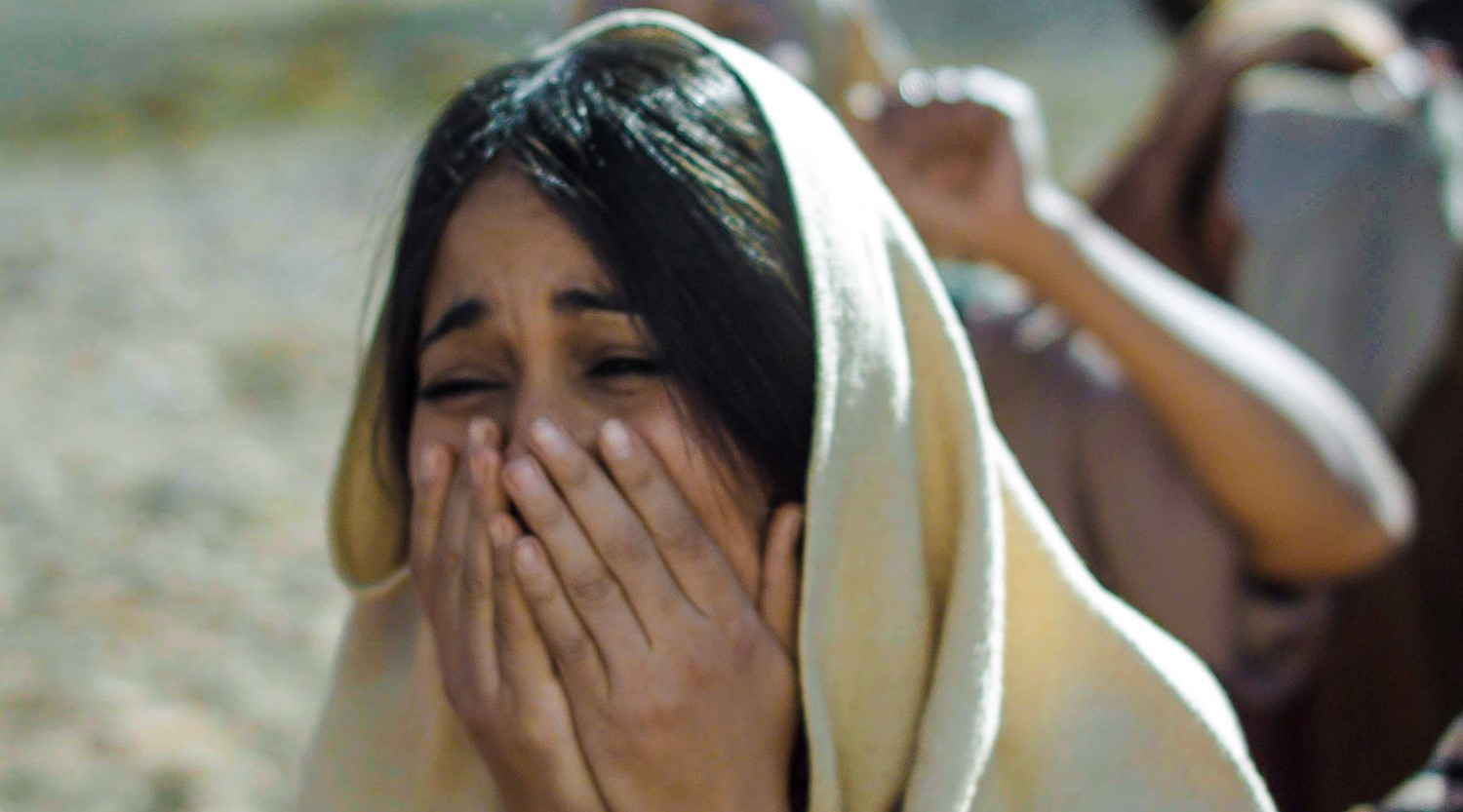
image (c) Lumo Project
Note: I am well aware that if I had written this reflection from the point of view of someone else, say one of those gathered with Jesus in the house, I would have written completely different. But this perspective caught and fascinated me. See my comments that follow the reflection.
James, the brother of Jesus, has a rant…
I hate to say it, but I honestly believe my brother has finally lost the plot!
The way he has been behaving lately got my mother, in particular, very worried. But the way he so rudely dismissed her and us yesterday was totally out of order! We had only gone there because we were concerned for him; but he threw that back right in our faces. Publicly too! I’m sure my mother will never get over the shame and humiliation!
Well, Jesus, we tried to help you; but now… you’re on your own!
Just so you know, reports about Jesus and what he was getting up to down here in Capernaum were regularly getting back to us in Nazareth. Recently, these reports were coming far more regularly and they were more outrageous by the day. We heard all about his sudden entry into a healing ministry; listened to long accounts about his run-ins with the authorities; got to know about the crowds and his choice of so called ‘disciples’. What was worse, however, were the shocking stories of demons and what they were saying about him. I know he insisted on shutting them up, but what if he’s begun to believe what they’re saying? With all this sudden popularity going to his head, I can see a ‘messiah complex’ brewing. That is, after all, what they keep telling him he is! In any case, Mum knew he wasn’t sleeping or eating properly and with the crowds demanding every ounce of him, he was bound to be getting exhausted. Time to fetch him home, she determined. I could not disagree.
My concern, however, wasn’t just for the state of his mental health; I had also heard what the teachers of the law were saying. Clearly, he had stirred up a hornet’s nest among them, because they had sent for specialist help from Jerusalem. They were determined to shut him up, obviously, and with him having to silence the noisy demons that followed him everywhere, what could they do better than pronounce him in league with Beelzebub (the prince of demons) himself? (Quite frankly, this was ridiculous, but is showed how desperate they were. Jesus had obviously rattled them and lines had been drawn.) So, now you see why we had to bring him home. If we didn’t act immediately, it might soon be too late!
Mind you, the reports of how Jesus handled his accusers didn’t really confirm the notion that he was a mad man; just the opposite, in fact.
He didn’t rant and rave, or accuse and curse in return; he quite simply and calmly pointed out the illogicality of their argument. ‘How can Satan drive out Satan?’ he asked. ‘You’ve heard of the tactic ‘’divide and conquer’’? Well, if Satan starts fighting against himself, then he’s going to fall, isn’t he? His end has come.’
Those who heard this – and Jesus’ parable about needing to tie up the strong man before going to rob his house – told me that they were impressed. Again, they found that Jesus spoke with a profound authority. And he took that authority and used it forcefully when he turned on his accusers and said: ‘Of all the blasphemies that you have ever come up with, none is more unforgiveable than this. There really is no hope for you when you convince yourselves that what is good is bad and denounce the Holy Spirit as the Devil himself! Nothing will ever convince you otherwise, will it? That’s why it’s unforgiveable.’
Hearing this report, I might almost have applauded my brother, except for one other thing he said to them: ‘A family divided against itself cannot survive’.
Oh, yes? Then why did you go and do what you did, big brother of mine? Why did you refuse to welcome, own or even acknowledge your own family? What you said was like a sword in our mother’s heart. It was certainly a slap in the face for the rest of us. ‘Who are my mother and brothers?’ You had the bare faced cheek to ask that while leaving us standing outside! And then, ‘Here they are!’ you said, pointing to all your new friends around you. ‘Whoever does God’s will is my brother and sister and mother.’
Well, Jesus, that may make sense to your twisted way of thinking, but I Just don’t know how you could say such a thing! If you ask me, you’ve gone way too far!
What is wrong with you?
How could you be so hurtful and ungrateful, especially to your mother?
Perhaps you are mad, after all?
And let me tell you now; you are welcome to your new family, if that’s how you feel!
And they are welcome to you!
Comment:
As I said above, I have doubt if I’d chosen a different character to speak I’d have written a very different reflection. No doubt, most of us would speak from the point of view of those listening to Jesus and hearing his wonderful words of welcome and inclusion, avoiding the awkwardness of his dealing’s with those outside.
I , myself was shocked by the intensity of James’ anger, as I imagined it. I had to check out my reading of this, and question assumptions I had held unquestioningly for years . When I did so, I found myself even more shocked by what I had missed.
I had always grown up with the impression that Mary was always there, in the background, herself a faithful follower of and devoted Mother to Jesus. But if we take an honest look at the gospels then we find that this is simply not the case.
Here in chapter Mark 3 we find an incident retold by Matthew and Luke. Jesus publicly snubs his family who had come seeking him out. He wont come out to meet them, and they have to leave. I imagine they may have been in quite a huff!
And this is the crunch: as far as Mark and the other synoptic gospels have it, this is the last we hear of Mary and the family. If we did not have John’s account of Mary at the crucifixion, we would have nothing more about her in any of the gospels from here on. We would be left to but to conclude that their relationship ended badly, right then and there.
Well, almost.
In his second volume, the book of Acts, Luke takes an enormous leap from the point of this family breakup, to describe the disciples, post-resurrection, meeting regularly in prayer ‘along with his mother and his brothers’ (Acts 1: 13-14). It seems that reconciliation has taken place. Where and when we do not know, although we do know Jesus travelled up to Nazareth soon afterwards. We have record of his rejection in the synagogue there (Mark 8 19-21 and parallels), but there is no explicit mention of his family being involved. Certainly there is no record of them trying to save him from the angry mob, as we might expect. Perhaps they did made up privately; we simply do not know.
John, as I have said, is the only gospel to include any later mention of Mary. She is there at the crucifixion, together with the disciple John, even though the other disciples did not have the courage to stand beside him in his suffering. Perhaps it is from this passage we get the impression that Mary stuck with him to the end – a model of faithful motherhood. But that is stretching the evidence, as this is the only mention of Mary with Jesus after the early family spilt up (or after the wedding at Cana according John). Other Marys are mentioned, but the mother of our Lord is not even recorded as being present at any resurrection appearance.
So where does this leave us ?
Leaving aside a simple moralistic tail about obeying your parents gleaned from the account of Jesus childhood in Luke 2 (not my style!), all I am left with is the idea that Jesus’ relationship with his mother and family was a chaotic and painful mess. But this might be Good news! The idea that Jesus came from a dysfunctional family with deep divisions within it rings true to the experience of many. Jesus’ family abandon him, perhaps feeling badly hurt. But reconciliation must have followed. How and when, we are not clear, but it seems that it did. We have hints of Jesus making the long journey home to facilitate it – but the fact that we have no clear account of the reconciliation saves us from looking for an easy blue print into a very messy situation. We simply have a hope and a goal, and the acknowledgement that messy things happen in families and they have to be worked through.
Personally, I think that gives us a lot to think about.
John’s account of Jesus and Mary at the crucifixion may strengthen the argument. As Jesus speaks compassionately to Mary and John he restores a mother-son relationship being lost by his death. In doing so he stresses the need for us to love and care for one another, as family, even if we are not blood relatives, even if we have lost or been hurt by blood relatives.
This may have been the good news of Jesus’ preaching at the time he upset his mum and brothers. ‘Who are my mother and brothers’ he asked ‘but those who do what God asks of them?’ He is probably not deliberately rejecting his birth family (even if they may well have heard it that way.) Rather he is expressing a new way of being family – a way in which the full delights and privileges of ‘family’ are not restricted by DNA and legal inheritance. It is there, even, for the many whose blood relatives have caused them pain; the many who have experienced family in many different and sometimes dysfunctional forms; and the many who have lost of never known children (or mothers) of their own.
Remember , what ever Jesus’ brother James may have thought at the time, reconciliation came big time. James goes on to be leader of the Church in Jerusalem and ultimately to give his life as a Christian martyr!
 Marking The Moment
Thank you again so much for this Nick, and especially for being so clear in how outspoken Jesus was and how vehemently James vented his anger. Thank you for adding your conclusion also at the end, and again it is being posted on Tabernacle’s Facebook page. Many, many thanks for yet another thought-provoking insight.
LikeLike